
Thailand - Bangkok
Bangkok is one of those cities that you either take to immediately or spend your entire visit wondering what on earth all the fuss is about.
Fortunately, I was firmly in the first camp. It is noisy, hot, humid, crowded and occasionally completely chaotic, but that is also what makes Bangkok so fascinating. It is a city with enormous personality, and underneath all the traffic, skyscrapers, shopping malls and general mayhem is a remarkable amount of history and culture.
What makes Bangkok particularly interesting is the contrast. One minute you can be standing in front of a magnificent Buddhist temple that looks as though it has hardly changed for centuries, and a few minutes later you are surrounded by modern shopping centres, elevated railways and glass skyscrapers. Bangkok manages to put the ancient and the ultra-modern together in a way that somehow works.
And then there is the heat. Bangkok is not somewhere to visit if you dislike sweating. It can be absolutely exhausting walking around, particularly when visiting the temples, so the sensible approach is to take things steadily, drink plenty and make good use of the air conditioning whenever you find it.
Getting around
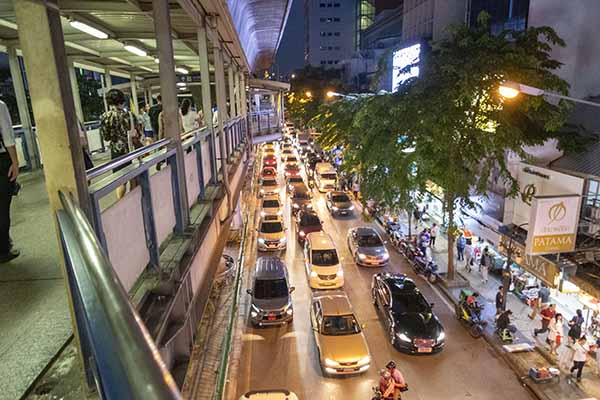 Bangkok's traffic is legendary, and with good reason.
Taxis, buses, tuk-tuks, motorbikes and cars all seem determined to occupy the same piece of road at the same time. Sitting in a traffic jam while watching a motorbike weave effortlessly through the stationary traffic can be particularly irritating.
Tuk-tuks are great fun for the experience, but I wouldn't necessarily recommend them for every journey. Agree the price before you set off and remember that the driver knows you are a tourist.
Fortunately, modern Bangkok has an excellent alternative in the BTS Skytrain and MRT network. They are fast, air-conditioned and, most importantly, they allow you to escape the traffic.
For the historic centre, however, the river boats can sometimes be the most enjoyable way of getting around.
The Grand Palace and Wat Phra Kaew
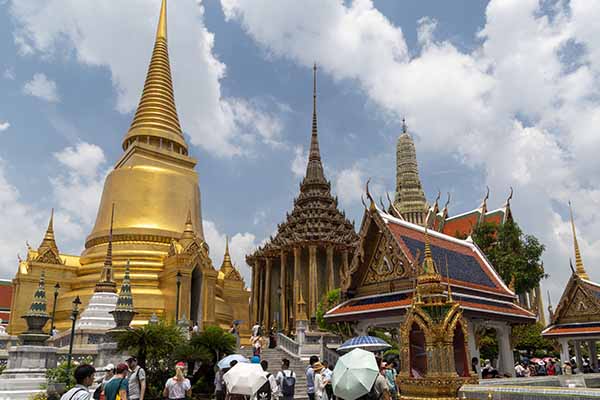 If there is one place that absolutely has to be visited in Bangkok, it is the Grand Palace. It is the city's great architectural showpiece and was established when Bangkok became the capital in 1782. The complex covers an enormous area and contains a mixture of royal buildings, ceremonial halls and temples.
The star attraction is Wat Phra Kaew, the Temple of the Emerald Buddha. The Emerald Buddha itself is surprisingly small considering its importance, but the temple surrounding it is spectacular. Gold, coloured glass, elaborate decoration and intricate details seem to be everywhere you look.
There is almost too much to take in, and this is one of those places where simply wandering around and looking upwards is worthwhile. Bangkok certainly doesn't do understated temples.
The Grand Palace is still used for royal ceremonies, although the Royal Family no longer lives there. For foreign visitors, admission is currently 500 baht (£11.25 and includes Wat Phra Kaew.
One word of warning: this is a place where you need to dress appropriately. No shorts, sleeveless tops or skimpy clothing. This isn't simply a tourist attraction; it is a place of considerable religious and royal significance, so the rules are rightly taken seriously.
Wat Pho and the Reclining Buddha
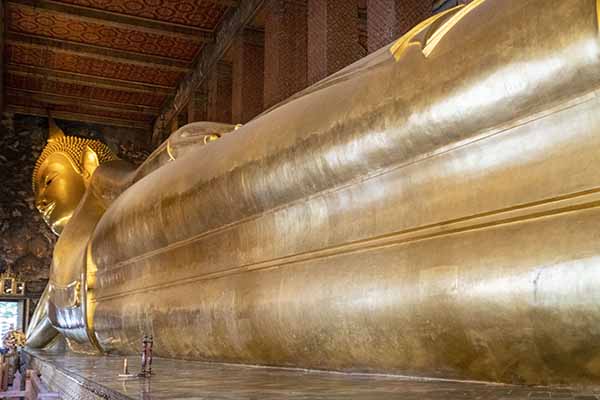 Just a short walk from the Grand Palace is Wat Pho, and this is another Bangkok essential.
The reason most visitors come is the enormous Reclining Buddha, a 46-metre-long gold-covered statue which is genuinely impressive. It is one of those sights where photographs really don't convey the scale particularly well.
But Wat Pho is considerably more than one enormous Buddha. The temple complex is filled with stupas, statues, murals and beautifully decorated buildings. It is also closely associated with traditional Thai massage, with a massage school operating within the temple complex.
The combination of the peaceful temple grounds and the sheer amount of decoration makes Wat Pho one of my favourite places in Bangkok. It is busy, inevitably, but somehow it feels less overwhelming than the Grand Palace.
Admission for foreigners 300 bhat (£6.75)
Wat Arun – the Temple of Dawn
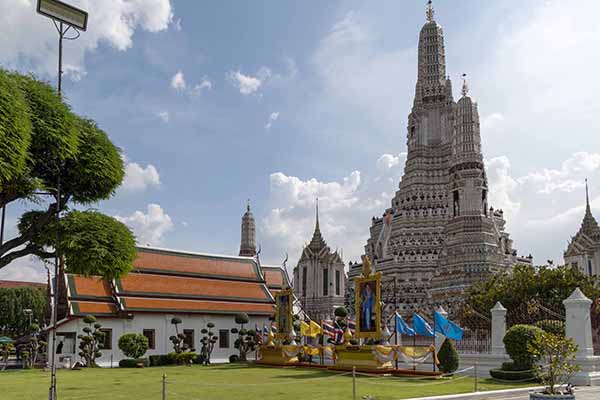 Then there is Wat Arun, sitting dramatically beside the Chao Phraya River.
This is one of the images of Bangkok that you will see everywhere, and thankfully it really does live up to the photographs. Its huge central prang is covered with intricate decoration and looks particularly impressive from across the river.
There is something very satisfying about travelling across the Chao Phraya on a small ferry and seeing Wat Arun getting larger as you approach. It is one of those simple Bangkok experiences that is far more enjoyable than being ferried around in an expensive tourist bus.
Wat Arun dates back to the Ayutthaya period and its riverside location has made it one of Bangkok's most recognisable landmarks.
Admission for 200 bhat (£4.50)
The Chao Phraya River
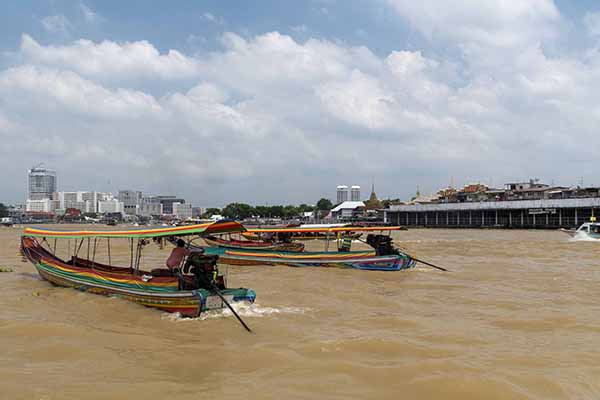 The Chao Phraya is the artery of Bangkok and, for me, one of the best ways of seeing the city.
The river gives you a completely different perspective. Modern buildings rise behind traditional houses, temples appear between the buildings and boats of every description are constantly moving up and down the water.
You also get a welcome break from the traffic.
The river isn't exactly pristine, but it is fascinating. Bangkok has grown around it, and the river remains an important part of everyday life as well as tourism. Express boats provide a practical way of getting around some of the historic parts of the city, rather than simply being a tourist attraction.
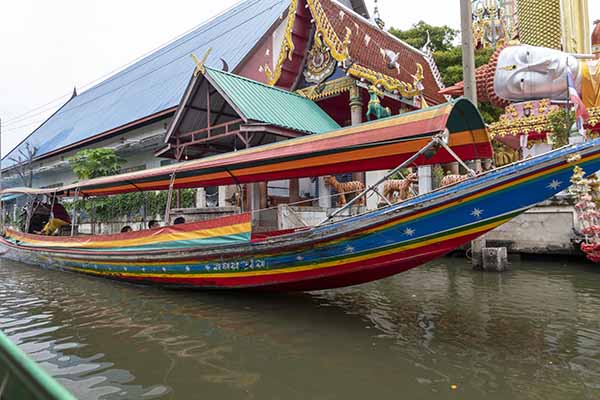
You can book a long-tail boat tour which will take you round the canals of Bangkok and, yes, there are lots of canals, more than Venice, which are often overlooked by the tourists. You will see a different side to Bangkok with properties made of corrugated iron clinging on to the side of the canal - they still come equipped with satellite dishes though. It will cost around 1,900 bhat (£$2.50) for a one hour tour for 2-4 people.
Asiatique The Riverfront
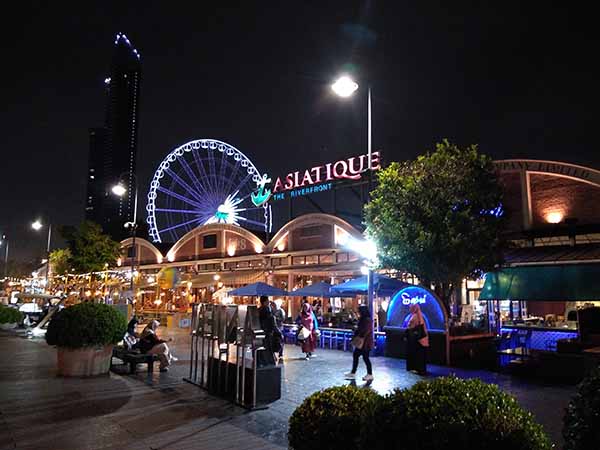 For something completely different, head down to Asiatique The Riverfront, a large riverside entertainment and shopping complex on the Chao Phraya.
 Asiatique The Riverfront It occupies the site of Bangkok's old East Asiatic Company trading area, with the old warehouse buildings restored and turned into shops, restaurants and entertainment venues.
Today it is a particularly good place to visit in the late afternoon and evening, when the heat begins to ease and the whole waterfront comes alive.
There are plenty of shops and restaurants, a 300-metre riverside promenade and, of course, the rather impressive 60-metre Asiatique Sky Ferris wheel, which gives you wonderful views across the river and the Bangkok skyline.
I particularly liked the atmosphere here; it is touristy, certainly, but in a pleasant rather than irritating way, and sitting beside the Chao Phraya watching the boats go past while Bangkok lights up around you is a very enjoyable way to spend an evening.
Even getting there is part of the fun, with a free shuttle boat running from Sathorn Pier near BTS Saphan Taksin.
Markets and shopping
Bangkok is almost dangerous for anyone who enjoys shopping.
There are enormous modern shopping centres where you can find virtually every international brand imaginable, but personally I think the markets are much more interesting.
Chatuchak Weekend Market is the famous one, and it is enormous. You can buy almost anything, from clothes and souvenirs to food and all manner of things you never knew you needed.
Then there are the smaller markets scattered around the city, each with its own character. Bangkok's tourism authorities list Chatuchak alongside places such as Sampeng Market, Yaowarat and Phahurat as some of the city's notable shopping areas.
And if shopping isn't your thing, don't worry. Bangkok has plenty of air-conditioned shopping malls where you can at least escape the heat for a while.
Food
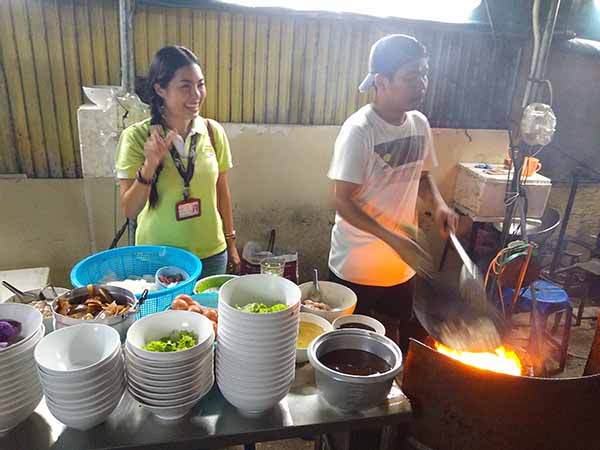 Bangkok is also one of those places where eating is part of the experience.
Street food is everywhere, and even if you aren't particularly adventurous, there is plenty to choose from. The smells drifting around the streets can be absolutely wonderful — although occasionally they can be considerably less wonderful!
Chinatown is particularly famous for its street food, but food stalls can be found throughout the city.
If you have a free evening, I can thoroughly recommend a Thai Food tour, you visit several different locations sampling different Thai delicacies. You even get to visit "behind the scenes" to see the food being prepared and cooked. There are various operators and a four hour tour would cost around £45 - £60 a head but is worth every penny.
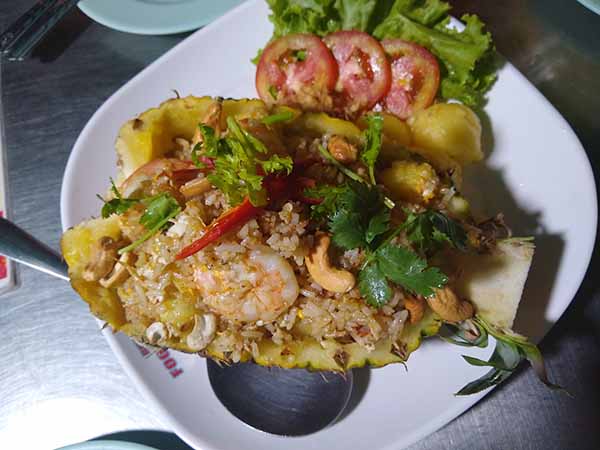 Personally, I think Bangkok is best experienced by eating where the locals eat rather than searching for somewhere that looks like it could be in London. Part of the fun is never quite knowing what you are going to find.
On one evening walk we found a stall selling pineapple, sliced in half, hollowed out and the pineapple mixed with rice and herbs and then filling the hollowed out shell, it was a delight.
The modern side of Bangkok
Away from the temples, Bangkok becomes a completely different city.
There are huge shopping centres, luxury hotels, office towers and skyscrapers seemingly everywhere. The skyline is constantly changing and the city feels energetic and ambitious.
This is where Bangkok really works for me. It isn't trying to preserve itself as some sort of giant historical museum. The old city is still there, but it has been surrounded by an enormous modern metropolis.
You can spend the morning looking at the Emerald Buddha, have lunch in a tiny street restaurant, travel by river boat, wander around Chinatown and finish the day looking at the Bangkok skyline from somewhere several dozen floors above street level.
That variety is difficult to beat.
So, is Bangkok worth visiting?
Absolutely.
Bangkok isn't beautiful in the traditional sense. There are parts that are dirty, congested and decidedly unattractive. The heat can be oppressive, the traffic can drive you mad and the sheer number of people can occasionally become exhausting.
 But then you turn a corner and find a magnificent temple.
Or a tiny shrine covered in flowers.
Or a street market selling food you have never seen before.
Or a long-tail boat racing along the Chao Phraya.
And suddenly you remember exactly why you came.
Bangkok is a city of contrasts, but unlike some cities where the old and new seem to fight each other, here they somehow coexist. Golden temples sit beneath modern skyscrapers, monks walk past shopping centres, traditional markets operate alongside enormous malls and ancient buildings share the skyline with some remarkably modern architecture.
It is noisy, chaotic, occasionally frustrating and completely fascinating.
Bangkok may not be everybody's cup of tea, but if you give it a chance, it is difficult not to be swept along by it.
Prices correct as at August 2026
Return to World Home Page