
Cambridge
Cambridge is one of those cities where it is almost impossible to escape the feeling that you are walking through history. Famous throughout the world for its university, it is an extraordinarily attractive place, with medieval buildings, ancient colleges, beautiful courtyards and the River Cam winding its way through the heart of it all. It is also, inevitably, packed with tourists — but unlike some famous destinations, Cambridge generally manages to justify the attention.
The University of Cambridge dates back to 1209 and is actually made up of 31 colleges, each with its own history, architecture and character. You don't need to be a student, or particularly interested in academia, to appreciate them. Colleges such as King's, Trinity, St John's and Queens' are architectural masterpieces, with magnificent courtyards, chapels and gardens.
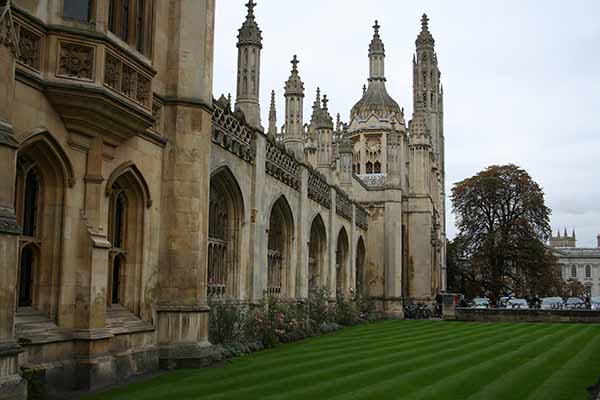 King's College is probably the most recognisable of them all, thanks largely to the magnificent King's College Chapel. Its enormous fan-vaulted ceiling is one of the finest examples of late Gothic architecture anywhere in England, while the famous Christmas Eve service of Nine Lessons and Carols has made the chapel familiar to millions who have never actually visited Cambridge.
Trinity College is another heavyweight, founded by Henry VIII and boasting some rather impressive alumni. Its Great Court is one of the most famous spaces in Cambridge and the college's Wren Library, overlooking the river, is particularly beautiful. It also has a rather splendid literary connection: Isaac Newton was once a student and fellow here, and the famous apple tree story is proudly remembered.
Then there is St John's College, whose Bridge of Sighs spans the Cam. Despite its name, it wasn't actually named after the famous Venetian bridge, but it has become one of Cambridge's most photographed sights. Queens' College has another famous crossing, the Mathematical Bridge, although the number of people who insist on believing it was built without any nails or bolts is rather larger than the number who understand how it was actually constructed.
And then we come to the river.
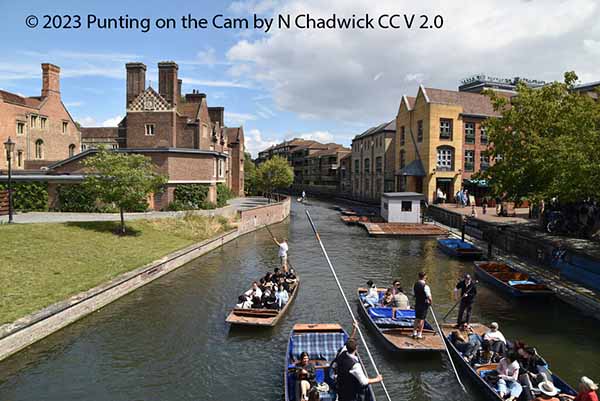 Punting on the Cam is almost compulsory for first-time visitors, although watching the professionals effortlessly glide along while you struggle to keep a straight course is probably more enjoyable than actually doing it yourself. The route takes you past the famous college 'backs', providing views of some of Cambridge's finest buildings that you simply cannot get from the streets. In summer, the river can become spectacularly busy, with punts, rowing boats and tourists seemingly determined to collide with one another.
The Fitzwilliam Museum is another Cambridge highlight and one of the finest university museums in Britain. Its collections cover everything from ancient Egyptian, Greek and Roman artefacts to paintings by some of Europe's greatest artists. Best of all, admission to the main collection is free, which is increasingly unusual for a major museum.
Away from the university, Cambridge has a perfectly respectable city centre with shops, cafés, pubs and restaurants, although the tourist trade is clearly never far away. Market Square has been the centre of city life for centuries, while the surrounding streets contain a mixture of medieval buildings, university architecture and rather less distinguished modern additions. As with so many historic British cities, somebody has occasionally decided that a concrete building would look perfectly acceptable next to a medieval one. They were, of course, wrong.
For something a little quieter, the Cambridge Botanic Garden is well worth visiting. Covering around 40 acres, it provides a welcome escape from the crowds and contains an impressive collection of plants from around the world. It is particularly attractive in spring and early summer, although there is plenty to see throughout the year.
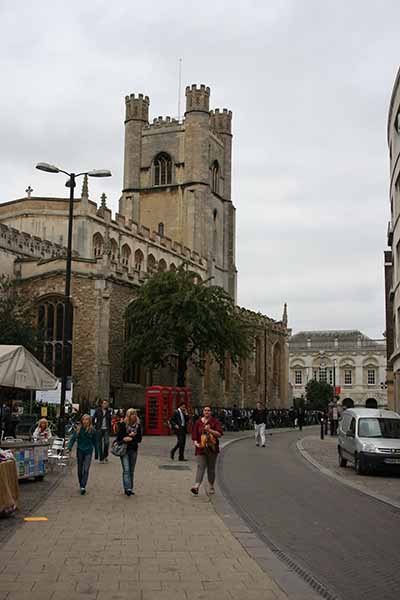 Cambridge also has a fascinating literary and scientific history. Alongside Newton, its university has produced an extraordinary collection of scientists, writers, politicians and academics. Charles Darwin, Alan Turing, Stephen Hawking, Lord Byron and A. A. Milne are among the many famous names associated with the university. It is one of those places where you can walk down an apparently ordinary street and discover that somebody who changed the world lived or worked in a building you had just walked past.
The city is also surrounded by some lovely countryside, and the flat landscape of the Cambridgeshire Fens provides a very different backdrop from the rolling hills found elsewhere in England. The contrast between the ancient university and the modern science and technology businesses around the city is particularly interesting. Cambridge may be steeped in tradition, but it is by no means stuck in the past.
The downside? Well, Cambridge can be very busy. In the height of summer, the centre can feel more like a tourist attraction than a working city, and accommodation and parking aren't cheap. The narrow historic streets don't exactly lend themselves to modern traffic either. Walking or using public transport is usually a much better idea than trying to drive into the centre.
But despite the crowds and the prices, Cambridge is difficult to dislike. The combination of ancient colleges, magnificent architecture, the River Cam, museums, gardens and centuries of history gives it an atmosphere that few other English cities can match.
It is undeniably touristy, undeniably expensive and undeniably full of people punting badly — but Cambridge has earned its reputation. If you haven't been, it is well worth a visit, and if you have, there is enough here to make you want to go back.
Return to East home page