
Olympia
Olympia is one of those places where you really ought to be impressed.
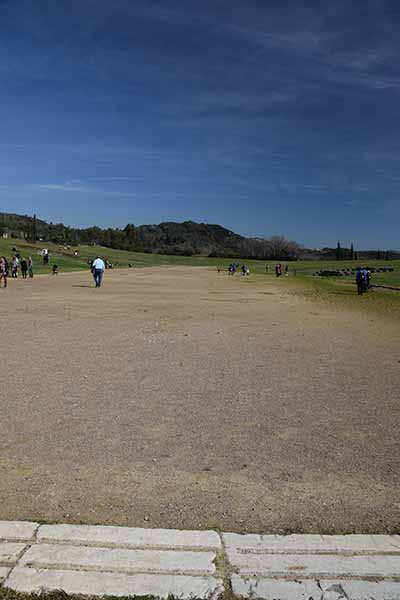 After all, this is where the Olympic Games began.
Not the version involving television rights, corporate sponsors, opening ceremonies lasting approximately four days and athletes being interviewed immediately after winning a medal.
The original version.
Thousands of years ago, athletes came here to compete in honour of the gods, and for a few days every four years the various Greek states were supposed to stop fighting one another and concentrate on sport instead.
Which, when you think about it, was a remarkably sensible idea.
If only somebody had thought of keeping it going.
Today, Olympia is a small town in the western Peloponnese surrounded by beautiful countryside, olive groves and hills. It isn't particularly large and there isn't a huge amount to the modern town itself.
But then you haven't really come here for the town.
You've come to see Olympia, and that is something rather special.
The Olympic Games
The Olympic Games were held at Olympia for many centuries, with the traditional date for the first recorded Games being 776 BC.
The Games were part sporting competition, part religious festival and part enormous gathering of the ancient Greek world. Athletes competed in events including running, wrestling, boxing, chariot racing and the pentathlon.
There was no synchronised swimming, No BMX, no breakdancing. And, thankfully, no television pundits.
The Games were dedicated to Zeus, and Olympia became one of the most important religious centres of the ancient Greek world.
The sanctuary contained temples, sporting facilities, administrative buildings and accommodation for visitors and competitors.
It was an enormous complex by ancient standards.
And although what remains today is largely ruins, there is something rather extraordinary about standing in the same place where people gathered more than two thousand years ago to compete.
The Archaeological Site
The archaeological site is the main reason for coming to Olympia.
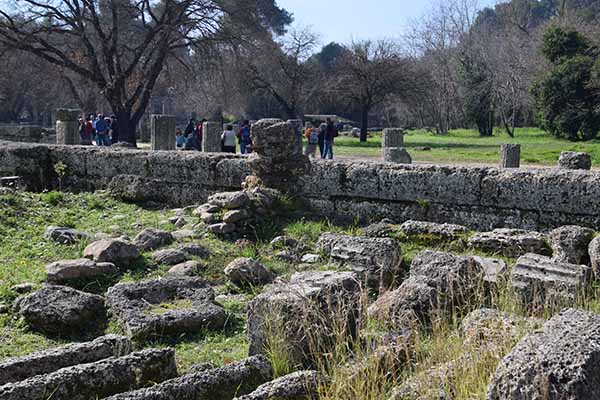 It sits in a wonderfully green setting at the foot of Kronos Hill, with trees and vegetation surrounding the ruins. This isn't one of those archaeological sites where you wander across a completely barren landscape wondering where everything went.
Here, nature has rather nicely taken over.
The remains of temples, sporting facilities and other buildings are scattered throughout the site.
The Temple of Zeus is particularly impressive, although what you see today is a collection of enormous fallen columns and ruins rather than the magnificent temple that once stood here.
It is still possible, however, to appreciate the scale.
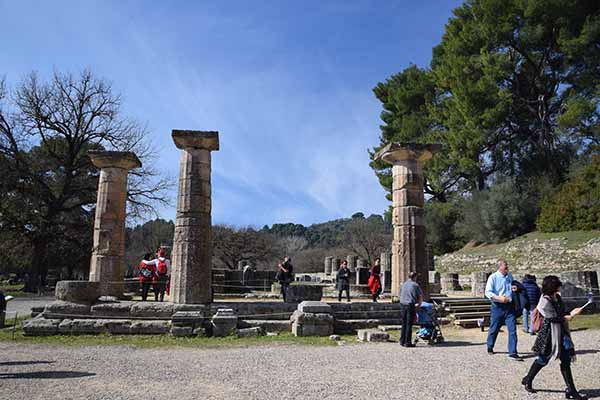
And then there is the Temple of Hera.
This is where the modern Olympic flame is traditionally lit before each Olympic Games, using the sun's rays in a ceremony that connects the modern Olympics with their ancient origins.
You don't need to be remotely interested in sport to appreciate the symbolism. It is actually rather moving.
The Stadium
Eventually you reach the stadium and this is where Olympia suddenly becomes much more real.
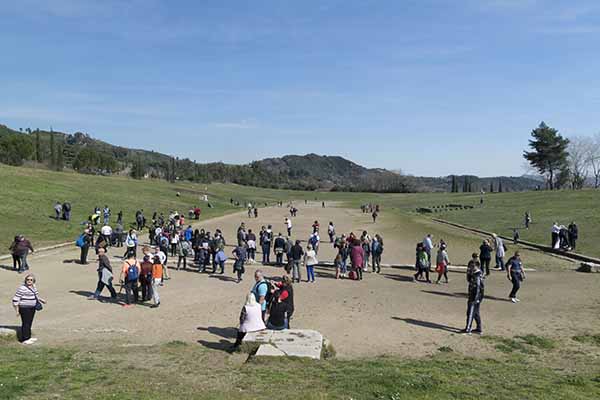 The ancient running track is still there. There are no grandstands, there are no electronic scoreboards, there are no giant screens.
There aren't even any seats for the spectators, there is simply a long strip of earth surrounded by grassy banks.
And yet you can almost hear the crowds.
The stadium could accommodate thousands of spectators and was the centre of the athletic competitions.
Standing at one end and looking down the track, it is remarkably easy to imagine an ancient athlete preparing for the race.
Although there is one rather obvious difference between then and now, The ancient athletes didn't have to worry about whether their trainers matched their kit.
In fact, they didn't have much kit at all, competitors famously competed naked.
Which probably saved an enormous amount of money on sportswear.
The Ancient Athletes
The athletes who came to Olympia weren't amateurs in the modern sense.
For many, sport was a serious business. Winning at Olympia brought enormous prestige, and successful athletes could become celebrities in the ancient world.
There were no gold medals, the winners received an olive wreath. Which sounds rather modest compared with modern Olympic medals, sponsorship deals and lucrative appearance contracts.
But in ancient Greece, becoming an Olympic champion could make you famous for the rest of your life. Statues were erected in honour of successful athletes, poets wrote about them and their home cities could reward them handsomely.
So the idea of sporting celebrity isn't remotely new, we've simply got better at selling it.
The Archaeological Museum
If you visit Olympia, don't make the mistake of seeing the ruins and then deciding you've seen everything.
You haven't.
The Archaeological Museum of Olympia is essential.
It contains many of the treasures discovered during excavations at the site, including some extraordinary examples of ancient Greek sculpture. Among the most famous is the Hermes of Praxiteles, one of the masterpieces of ancient Greek art.
There is also the magnificent Nike of Paionios and sculptures from the Temple of Zeus.
This is where some of the pieces that were once part of the ancient sanctuary can be appreciated properly.
The Museum of the Ancient Olympic Games
There is another museum devoted specifically to the history of the ancient Olympic Games.
It traces the development of the Games and helps explain what actually happened here rather than simply leaving you to wander around looking at piles of stones. The museum occupies the old archaeological museum building and contains objects associated with the Games and athletic competition.
It is particularly useful if you're interested in the sporting side of Olympia.
You discover what events took place, how athletes trained and how the Games fitted into the wider religious and political world of ancient Greece. And you begin to realise that the Olympics were considerably more complicated than simply running around a track.
The Modern Olympic Flame
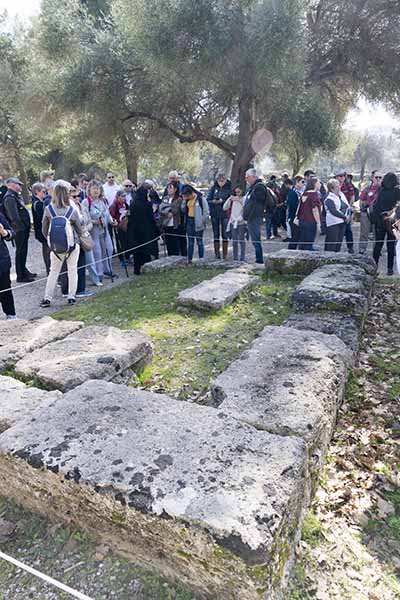 And then there is the modern Olympic connection.
The Olympic flame is lit at Olympia before each modern Summer Olympic Games. The ceremony takes place at the Temple of Hera and uses a parabolic mirror to focus the sun's rays.
From there, the flame begins its journey towards the host city.
It is one of those modern traditions that deliberately reaches back into ancient history and although the modern Olympics have little resemblance to the ancient Games in many respects, the symbolism is obvious.
The flame connects the two.
For a place that is essentially a collection of ruins, Olympia still manages to have an extraordinary influence on the modern world.
The Modern Town
And then there is the town of Olympia.
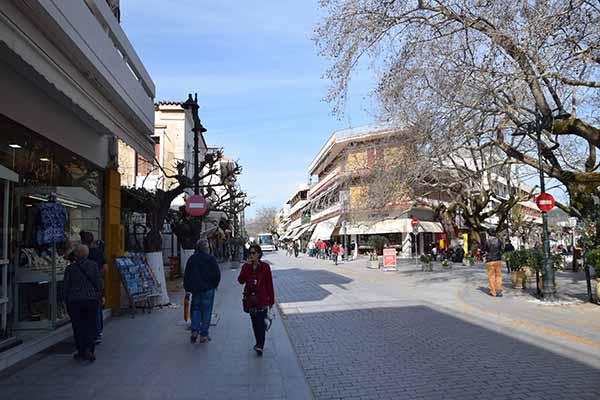 Let's be honest, it's pleasant enough but you're not going to need a week.
The town exists largely because people come to see the archaeological site, so there are hotels, restaurants, cafés, souvenir shops and the inevitable collection of businesses attempting to persuade you that you absolutely need another fridge magnet.
It is fairly compact and easy to explore.
There are also plenty of places to eat.
And after walking around the archaeological site in the Greek sunshine, sitting down with something cold to drink becomes considerably more attractive than it did when you arrived.
The Tourists
Olympia is understandably popular.
This is one of the most important archaeological sites in Greece and attracts visitors from all over the world.
That means tour groups, lots of tour groups. Cruise passengers are particularly common, with excursions bringing visitors from the port of Katakolon.
And there is something slightly amusing about watching a guide attempting to explain the history of ancient Greece to forty people while twenty more people are wandering through the middle of the group.
It can get busy.
But Olympia doesn't generally have quite the same overwhelming feeling of overcrowding as Santorini, for example, there is simply more space.
And the site itself is large enough that the crowds tend to spread out.
Is Olympia Worth Visiting?
 Yes.
Yes.Without question.
But it is worth understanding what Olympia is before you arrive.
If you're expecting another beautiful Greek town with a beach, nightlife and rows of restaurants, you'll probably be disappointed.
If you're interested in history, civilisation, archaeology or sport, you are going to find it fascinating.
The Old Moaner Verdict
Beautiful? Yes, although not in the Santorini sense.
Interesting? Absolutely.
Historically important? About as important as it gets.
Worth visiting the museums? Definitely.
Crowded? It can be, but the site is spacious enough to cope.
Expensive? The current official combined admission is €20 and includes the archaeological site and the associated Olympia museums.
Will you need sensible shoes? Yes.
Will you need water? Definitely.
Olympia is one of those places where you can stand in the middle of a ruined ancient stadium, look along the track and suddenly realise that people were doing exactly the same thing here thousands of years ago.
Prices correct as at August 2026
Return to Greece Home Page