
Oxford
The City of Dreaming Spires
There are few British cities with quite the instant impact of Oxford. You don't really need a sign telling you where you are. One look at the honey-coloured stone, ancient colleges, towers and spires rising above the rooftops and you know immediately.
This is the City of Dreaming Spires, a place of extraordinary history, magnificent architecture and one of the world's most famous universities. It is also a proper working city, with shops, restaurants, museums, markets and a population that has to cope with the rather unusual problem of sharing its streets with several centuries of history and a large number of students on bicycles.
And therein lies the Oxford experience.
The University
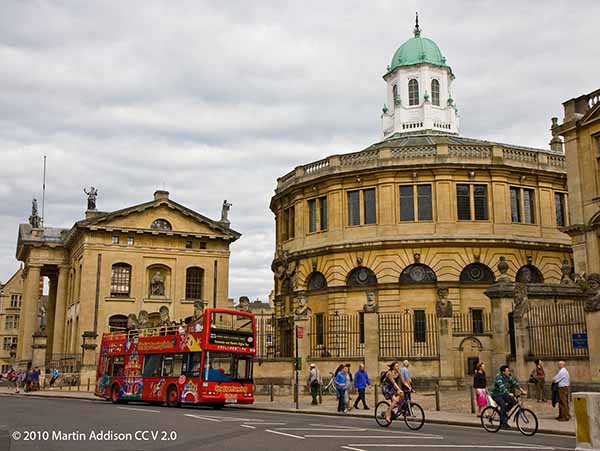 You can't really talk about Oxford without talking about the University of Oxford. Founded over 900 years ago, it is the oldest university in the English-speaking world, and its colleges dominate much of the city centre.
There isn't one enormous university campus. Instead, the university is made up of numerous individual colleges, each with its own buildings, courtyards, gardens, traditions and history.
Some of them are spectacular.
Christ Church, Magdalen, New College, Balliol, Merton and Brasenose are just a few of the names that will be familiar, even to people who have never been within a hundred miles of Oxford.
Walking through the college gates can feel like stepping into another world. Beautiful quadrangles, ancient stonework, cloisters, chapels and dining halls are everywhere.
And then you remember that these aren't museums.
Students still live and study in them.
Radcliffe Camera and the Bodleian
If there is one Oxford building that sums up the city, it is probably the Radcliffe Camera.
The magnificent circular library building is one of the most photographed sights in Oxford and forms the centrepiece of one of the city's most impressive architectural ensembles.
Nearby is the Bodleian Library, one of the great libraries of the world and another institution steeped in history.
The Bodleian's historic buildings include the Divinity School, Convocation House and Duke Humfrey's Library, and the whole area gives you a rather good idea of why Oxford has acquired its reputation for grandeur.
You don't need to be a scholar to appreciate it.
You just need a pair of eyes.
The Covered Market
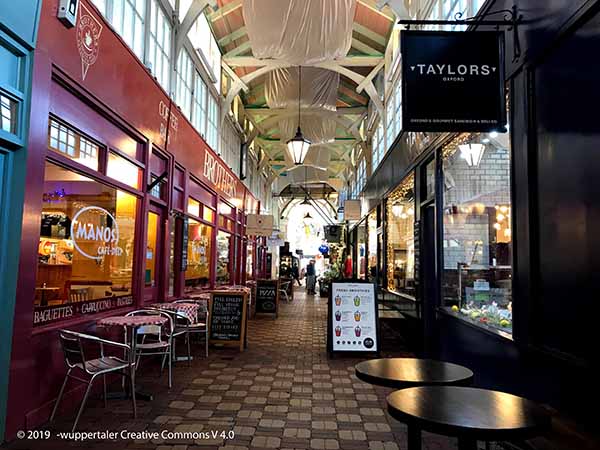 Thankfully, Oxford isn't entirely about ancient manuscripts and people wandering around in gowns.
The Covered Market is a good antidote to all that academic seriousness.
Established in the 18th century, it remains a lively shopping area packed with independent traders, food outlets, cafés, florists, clothes shops and all sorts of other businesses.
It is exactly the sort of place where you can wander around without having any particular objective and still find something worth stopping for.
And after several hours looking at priceless architecture, stopping for something edible is probably advisable.
The Ashmolean
If museums are your thing, Oxford has one of Britain's best.
The Ashmolean Museum is the world's first university museum and contains an extraordinary collection covering art, archaeology, antiquities and objects from cultures around the world.
It is the sort of museum where you could spend several hours and still only scratch the surface.
The collections range from ancient Egypt and Greece to European art and archaeological treasures, and the museum manages to combine enormous historical importance with exhibitions that are accessible to ordinary visitors.
Which is just as well, because I freely admit that my academic qualifications aren't going to impress anybody at Oxford.
The River and the Parks
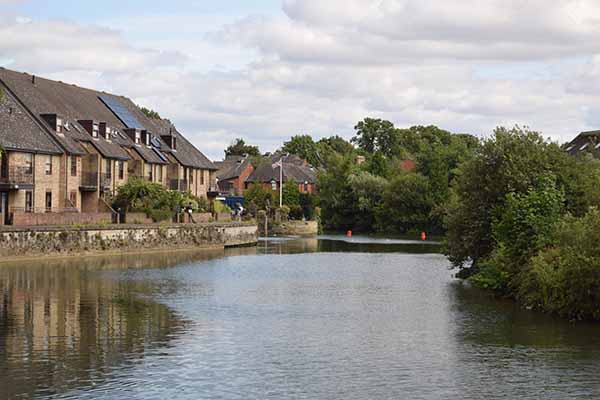 Oxford also has a surprisingly green side.
The River Thames and River Cherwell provide some wonderful opportunities to escape the crowds, while the city's parks and meadows give it a more relaxed character.
Christ Church Meadow is particularly lovely. It lies immediately beside the historic centre and offers wonderful views back towards the colleges and cathedral.
Then there is the traditional Oxford pastime of punting.
You can take to the water in one of those long, flat-bottomed boats and glide along the river while somebody at the back attempts to propel the thing using a long pole.
It looks wonderfully relaxing.
Unless you're the person holding the pole.
The Castles and the Darker Side
Oxford isn't all beautiful colleges and literary giants.
The Oxford Castle and Prison site provides a reminder that the city has a considerably darker history. The medieval castle was later used as a prison, and its remains now form a fascinating visitor attraction.
Oxford has seen religious conflict, civil war, political intrigue and executions over the centuries.
It wasn't always the peaceful academic haven that the postcards suggest.
A City Best Explored on Foot
The great advantage of Oxford is that much of the historic centre is compact enough to explore on foot.
In fact, walking is probably the best way to experience it.
Don't simply rush from Radcliffe Camera to Christ Church and then back to the car. Wander down the side streets. Look up at the buildings. Explore the quieter corners.
You will find ancient pubs, little lanes, bookshops, churches and buildings that seem to have been sitting there quite happily for hundreds of years.
The downside is that Oxford can be extremely busy.
During peak tourist periods, the centre can become crowded, and the combination of pedestrians, buses, taxis and bicycles can make getting around rather entertaining.
Oxford cyclists, incidentally, appear to operate under their own interpretation of the Highway Code.
Keep your eyes open.
The Verdict
Oxford is undoubtedly one of Britain's great cities.
It has history, architecture, literature, museums, rivers, parks and one of the world's most famous universities, all packed into a relatively compact area.
It is beautiful, but it isn't merely beautiful. Beneath the honey-coloured stone is a city with more than nine centuries of intellectual, political and cultural history.
There are times when it can feel a little too touristy, and the crowds can take some of the shine off the experience. Parking is another matter best approached with a sense of humour, and if you are driving into the centre you may discover that Oxford's traffic planners have a rather different definition of convenience to the rest of us.
But put all that aside and Oxford remains magnificent.
It is a city where you can stand beneath medieval towers in the morning, visit a world-class museum at lunchtime, wander through a college courtyard in the afternoon and finish the day beside the river.
And that's before you've even encountered the students, cyclists, punters and tourists.
The City of Dreaming Spires?
Absolutely. Just watch out for the bicycles.
Return to South East home page