
France - Marseille
Marseille is a difficult city to review because, like the city itself, it is a mixture of the very good, the very bad and quite a lot in between. France's second city has more than 2,600 years of history, a spectacular Mediterranean setting and some genuinely wonderful sights. It also has a reputation for being rough around the edges, and unlike some French cities that reputation isn't entirely undeserved.
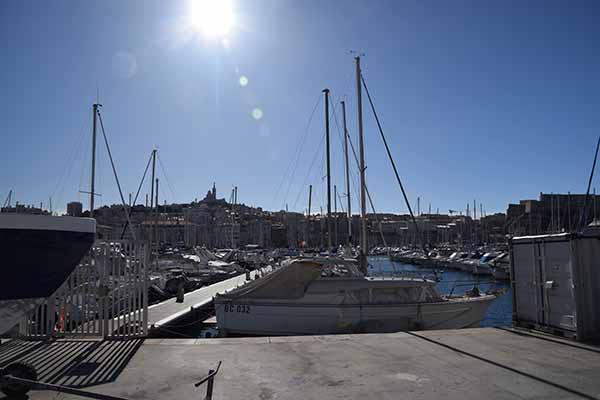 The obvious place to start is the Vieux-Port, the old harbour and the real heart of Marseille. It has been the centre of the city since ancient times and today is lined with restaurants, cafés and boats, with the impressive Fort Saint-Jean guarding one side of the entrance. It is a pleasant place to wander, particularly in the morning when the harbour is at its liveliest, although you will soon discover that Marseille isn't the sort of place where you can wander around completely oblivious to your surroundings.
From the harbour, look up and you will see Marseille's most famous landmark, Notre-Dame de la Garde. The basilica sits on a 154-metre hill above the city and is affectionately known as the Bonne Mère, or Good Mother. It is well worth making the climb, although those who don't fancy walking uphill can take the bus or tourist train. Once at the top, the 360-degree view across Marseille, the Mediterranean and the offshore islands is superb.
The basilica itself is rather spectacular too, with its Roman-Byzantine architecture, mosaics and the enormous gilded statue of the Virgin Mary looking out over the city and sea. Even if churches aren't normally your thing, this one is worth seeing. More importantly, don't miss the view.
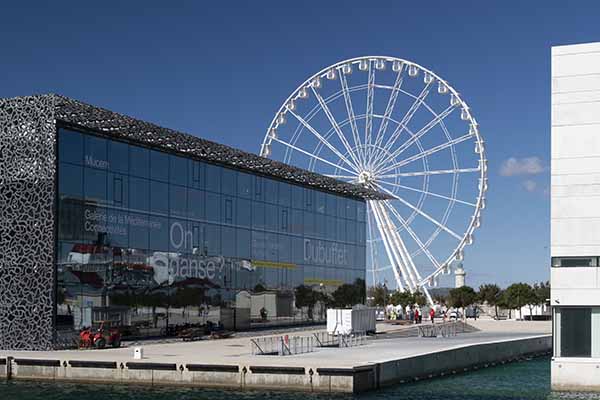 Down at sea level, the MuCEM – Museum of European and Mediterranean Civilisations is another of Marseille's modern highlights. The building itself is almost as interesting as the exhibitions, with its distinctive latticed concrete exterior beside Fort Saint-Jean. You don't necessarily need to be a museum fanatic to enjoy it because the setting, terraces and views across the harbour are attractions in their own right.
Nearby is Le Panier, the old quarter of Marseille. This is the area of narrow streets, colourful buildings, little squares, cafés and steep stairways that many visitors imagine when they think of the city's historic side. It is interesting to explore, although once again you need to remember that this is a real neighbourhood rather than a sanitised theme park created solely for tourists.
Marseille's history is extraordinary. The city was founded by the Greeks more than 2,600 years ago, making it one of France's oldest cities. There are therefore plenty of reminders of its past, including the archaeological remains of the ancient Greek and Roman settlement. The Port Antique and Marseille History Museum are particularly worthwhile if you want to understand how this rather remarkable city developed.
Then there are the Calanques, and frankly this is where Marseille really starts showing off. The coastline south and east of the city is spectacular, with dramatic limestone cliffs dropping into brilliantly blue Mediterranean water. The Calanques National Park provides some magnificent walking and boating opportunities and is a welcome escape from the bustle of the city. It is also one of the great advantages of Marseille: you can be in a major French city one minute and surrounded by spectacular natural scenery the next.
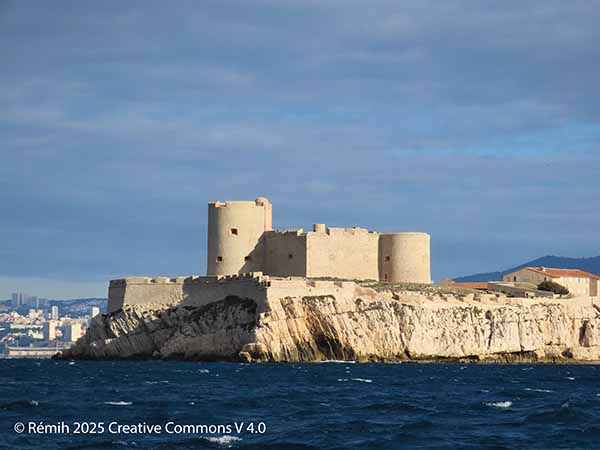 If you have time, take a boat trip along the coast or out towards the Frioul Islands and Château d'If. Château d'If is particularly famous for its appearance in Alexandre Dumas's The Count of Monte Cristo, although the real history of the fortress is considerably less romantic than the novel suggests.
Marseille also has some pleasant green spaces, including Parc Borély and the Palais Longchamp. The latter is particularly impressive, with its enormous 19th-century palace and fountain complex. They provide useful breathing space if you've had enough of traffic, buildings and people.
And then there is the food. Marseille's signature dish is, of course, bouillabaisse, the traditional Provençal fish stew. You will find it everywhere, although the good versions can be expensive and the cheap versions are best treated with suspicion. There is also the city's famous panisse, made from chickpea flour, and the ubiquitous pastis. Marseille takes its food and drink seriously, and rightly so.
So, would I recommend Marseille?
Yes — but with reservations.
It is not the polished, manicured France of places such as Annecy or the Loire Valley. Marseille is noisy, busy, occasionally scruffy and has a distinctly rough-and-ready character. Some streets are much less attractive than others, and you should take sensible precautions with your belongings, particularly in crowded tourist areas.
But perhaps that is also part of its appeal. Marseille feels like a real city rather than a museum piece. It has survived more than two and a half millennia and still has an enormous personality. The harbour, Notre-Dame de la Garde, the old quarter, the MuCEM and, above all, those magnificent Calanques make it worth visiting.
Marseille isn't necessarily beautiful in the conventional French sense, but it is fascinating, dramatic and completely itself. And sometimes that is considerably more interesting.
Prices correct as June 2026
Return to France home page