
France - Normandy
Normandy is another part of France that feels remarkably familiar to a British visitor, which isn't surprising when you consider how close it is across the Channel and how intertwined the histories of Britain and Normandy have been for centuries.
But Normandy is much more than somewhere you pass through on the way to somewhere else. It has some of France's most spectacular coastline, beautiful villages and towns, magnificent historic buildings, the extraordinary Mont-Saint-Michel and, of course, some of the most important battlefields of the Second World War.
Then there is the food. Normandy has a rather wonderful habit of producing things that are extremely good for you in moderation and absolutely terrible for your waistline if you get carried away. Butter, cream, apples, cider and cheese feature heavily.
And frankly, that sounds like a perfectly good reason to visit.
Bayeux
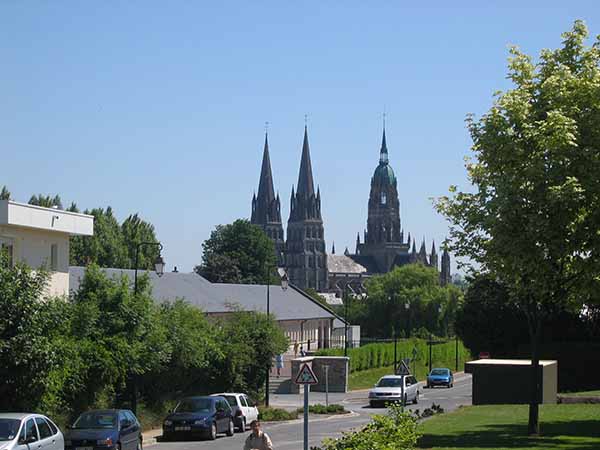 If there is one town that immediately comes to mind when thinking about Normandy, it is Bayeux.
Its greatest treasure is the famous Bayeux Tapestry, an extraordinary piece of medieval embroidery telling the story of the Norman conquest of England in 1066. It is nearly 70 metres long and provides an astonishing visual record of William the Conqueror's invasion.
The town itself is also well worth exploring, with its attractive historic centre and magnificent cathedral.
But Bayeux has another important place in history.
It survived the Second World War relatively intact and subsequently became an important base for visitors exploring the D-Day beaches. The combination of 1066 and 1944 makes Bayeux almost a condensed history lesson in Anglo-Norman relations.
The D-Day Beaches
For many visitors, however, Normandy means D-Day.
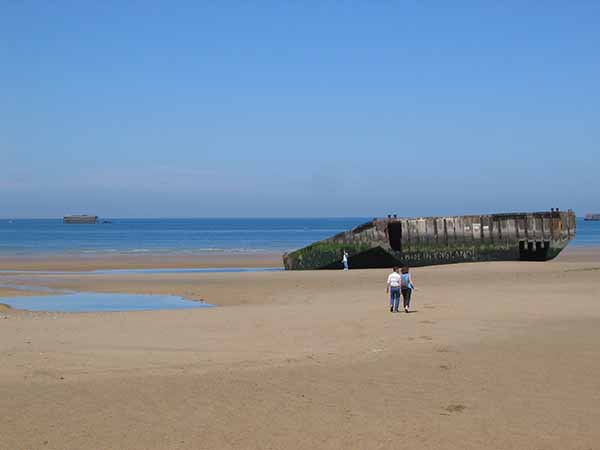 On 6 June 1944, Allied forces landed along the Normandy coast in the largest seaborne invasion in history. The beaches now have names that are familiar to anyone with even a passing interest in the Second World War: Omaha, Utah, Gold, Juno and Sword.
Standing on them today is an extraordinary experience.
They are beaches.
People walk along them, children play, the sea comes and goes with the tide and, on a sunny day, they can look almost idyllic.
Yet in June 1944 these same beaches were under intense fire and thousands of men were killed or wounded.
Omaha Beach is probably the most famous and perhaps the most difficult to contemplate. The enormous cemetery at nearby Colleville-sur-Mer contains more than 9,000 American military graves, looking out over the beach where so many of those men died.
The Normandy American Cemetery is one of those places where conversation tends to stop.
The rows of white headstones seem to go on forever.
And once again, the sheer number of young lives lost becomes more powerful than any statistics.
Pointe du Hoc
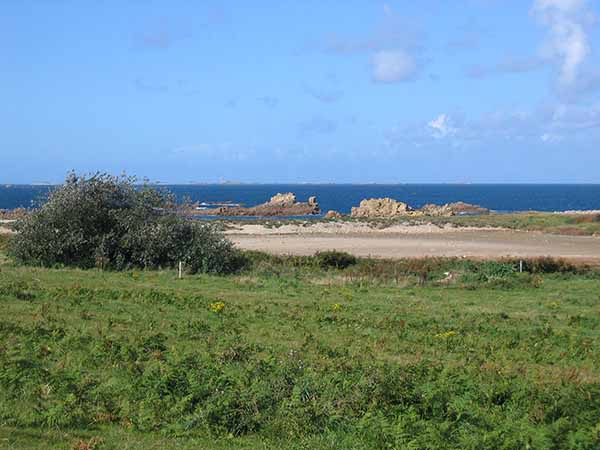 Another extraordinary D-Day site is Pointe du Hoc, where American Rangers scaled the cliffs to attack German gun positions.
The landscape still bears the scars of the bombardment, with enormous bomb craters scattered across the ground.
It is one of those places where history is unusually visible.
You aren't simply looking at a museum display telling you that bombs were dropped here.
You are standing in the craters.
You can see the remains of the German positions.
And you can look down at the cliffs that the Rangers had to climb under fire.
It makes the bravery — and the insanity — of what happened here much easier to appreciate.
Mont-Saint-Michel
Then there is Mont-Saint-Michel, which is arguably one of the most spectacular sights in France.
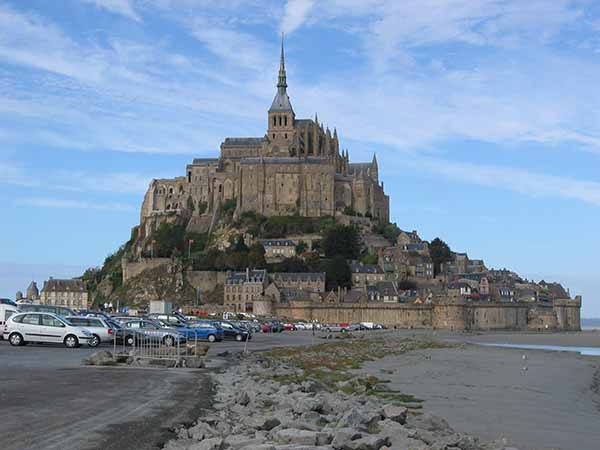 Technically sitting just across the regional border in Normandy's neighbouring area, it is far too important to leave out of any Normandy trip.
The medieval abbey rises dramatically from its rocky island, surrounded by the enormous tidal bay.
It looks almost unreal.
At high tide, the Mont appears to float in the sea. At low tide, vast stretches of sand surround it.
Inside, the medieval streets climb steeply towards the abbey, with restaurants, shops and tourists filling almost every available space.
And yes, it is crowded, Very crowded.
But sometimes a place is popular for a reason.
Mont-Saint-Michel is one of those sights that really does justify the crowds.
Rouen
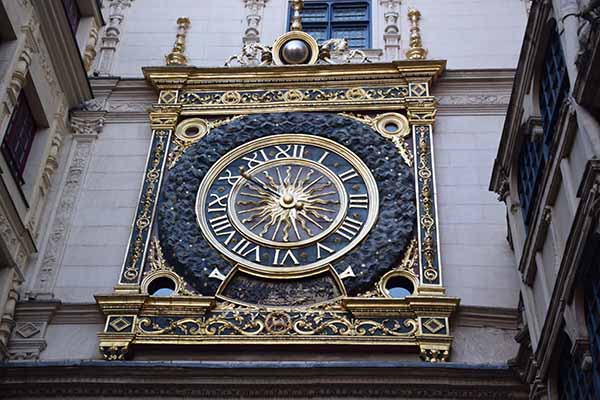 Rouen is Normandy's historic capital and another city with a remarkable story.
The cathedral dominates the centre and became famous through the paintings of Claude Monet, who painted it repeatedly under different lighting conditions.
But Rouen's history goes considerably further back.
This is the city where Joan of Arc was tried and executed in 1431, and the medieval centre still contains plenty of reminders of its past.
The old streets are particularly attractive, with timber-framed houses leaning over narrow lanes.
And then there is the modern city around them, reminding you once again that these historic places aren't museums — they are living cities.
Giverny
Just inland from the Seine lies Giverny, a small village that became forever associated with the great Impressionist painter Claude Monet.
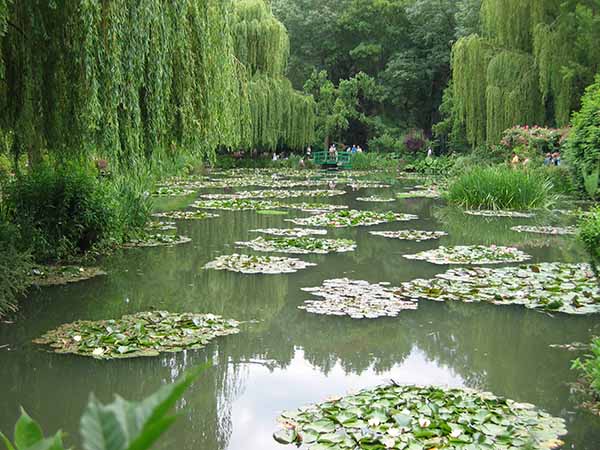 Monet lived here for more than 40 years, and his house and gardens are now one of Normandy's most popular attractions.
 The gardens are beautiful, particularly in spring and summer, with an extraordinary variety of flowers filling the borders. But the real highlight is the famous water garden, with its Japanese bridge, pond and water lilies — the very scenes that inspired some of Monet's most celebrated paintings.
Walking around it is rather strange because you can recognise the views from the paintings, although obviously the real thing has far more colour and movement.
The village itself is pleasant but tiny, so Giverny is really about Monet and the gardens rather than being somewhere you need to spend a whole day exploring.
It can get extremely busy, but if you are interested in art or simply enjoy beautiful gardens,
Giverny is well worth the detour. And there is something rather special about standing beside the pond and looking at the scene that Monet himself looked at while creating some of the world's most famous paintings.
Honfleur
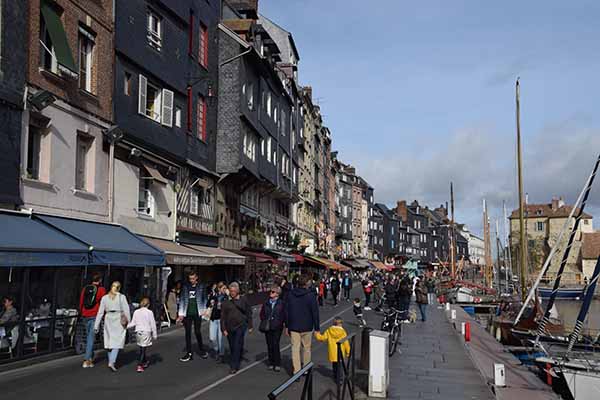 If Rouen is grand, Honfleur is charming.
The little harbour is surrounded by colourful buildings and restaurants, with boats packed into the water.
It is one of those places where you can happily spend several hours doing absolutely nothing except wandering around, looking at the buildings and stopping for lunch.
Honfleur also has an important artistic connection. Its light and harbour attracted painters including Monet and other Impressionists, helping inspire the movement that would change European art.
And it is very easy to understand why.
The harbour is exceptionally photogenic.
Étretat
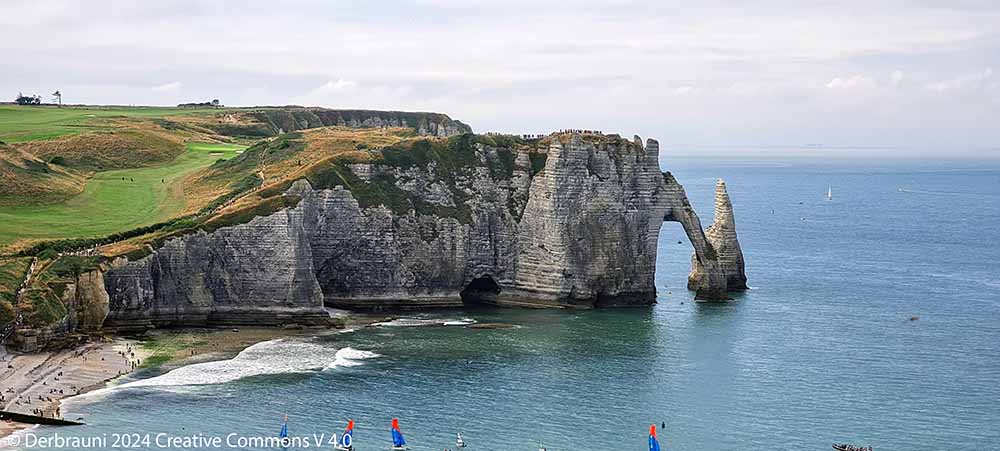
For something more dramatic, head to Étretat.
The cliffs here are magnificent, with enormous chalk arches and rock formations projecting into the English Channel.
The most famous is the Porte d'Aval, the great natural arch that has become one of Normandy's iconic images.
The cliffs are beautiful from the beach, but the views from above are even better.
Just don't get too close to the edge.
The sea may look peaceful from above, but this is still a wild coastline and the cliffs are very high.
The Norman Countryside
Away from the coast, Normandy becomes a completely different proposition.
The countryside is green, gently rolling and dotted with farms, orchards and attractive villages.
The Pays d'Auge is particularly beautiful, with traditional half-timbered houses, apple orchards and lush pasture.
It is the sort of countryside where you really want to leave the main roads and explore the smaller ones.
You never quite know what you are going to find around the next corner.
And if you suddenly discover a village with a little bakery selling something you absolutely have to try, that's all part of the experience.
Now, About That Cheese...
This is where Normandy really comes into its own.
There are four Normandy cheeses with AOP/PDO status: Camembert de Normandie, Livarot, Pont-l'Évêque and Neufchâtel. There is even an official Normandy Cheese Route taking you through the villages and producers associated with them.
And frankly, if you like cheese, you could build an entire holiday around it.
Camembert
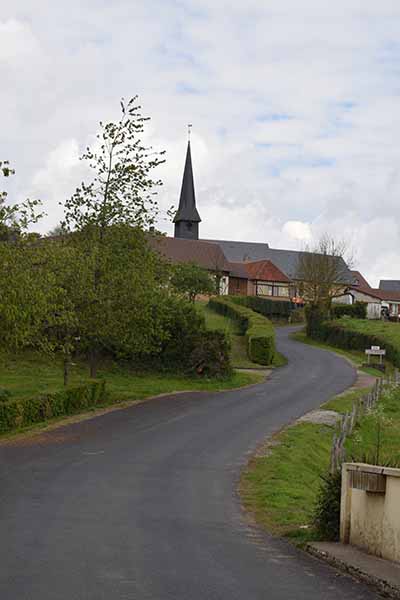 The obvious star is Camembert.
The village of Camembert actually exists, which is rather wonderful, and the cheese is deeply associated with the area. The modern story of Camembert is traditionally linked to Marie Harel, a Norman farmer's wife, in the late eighteenth century.
Real Camembert de Normandie is a world away from some of the mass-produced versions you find in supermarkets.
It is soft, creamy, aromatic and, when properly ripe, gloriously runny.
If you buy an authentic box of Camembert you will find their logo, which also happens to be the local parish church
Put it on a piece of fresh French bread and you have one of life's simpler pleasures.
Livarot
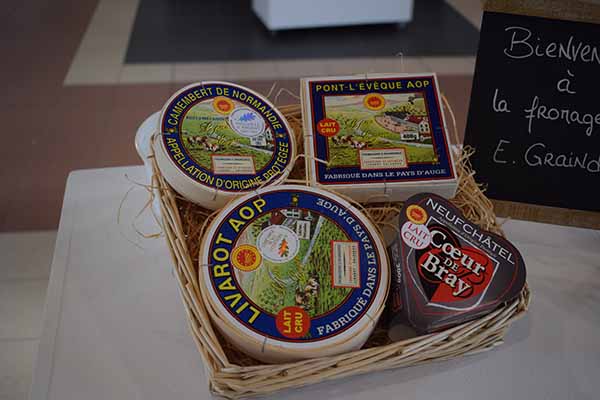 Then there is Livarot, which is rather more assertive.
It has a washed orange-coloured rind and is traditionally wrapped with five strips of reed, earning it the nickname "The Colonel." It has been produced in Normandy for centuries and has considerably more personality than its rather innocent appearance might suggest.
This is not a cheese that quietly sits in the corner.
You know when Livarot is around.
Pont-l'Évêque
Pont-l'Évêque is softer and creamier, and is another cheese with a long history, with production associated with Cistercian monks from the twelfth century.
It is a square, washed-rind cheese with a lovely creamy texture.
Put several Normandy cheeses on a board together and Pont-l'Évêque is probably the one that quietly disappears while everyone is arguing over the Camembert.
Neufchâtel
And then there is Neufchâtel, which has perhaps the best appearance of all.
It is traditionally made in a heart shape.
There is a lovely old story that young women gave heart-shaped Neufchâtel to English soldiers during the Hundred Years' War as tokens of affection. Whether the story is entirely true is another matter, but it certainly makes for a good tale over the cheese board.
Cider, Calvados and Apples
Cheese isn't the only thing Normandy does exceptionally well.
The region is covered in apple orchards and produces some excellent cider, as well as Calvados, the famous apple brandy.
The Pays d'Auge is particularly associated with cider, Calvados and poiré, a pear-based drink.
And apples turn up in the food too.
Normandy's cuisine makes extensive use of cream, butter and apples, which means that if you are counting calories, this probably isn't the French region for you.
Personally, I would suggest forgetting about the calories.
You're on holiday.
Seafood
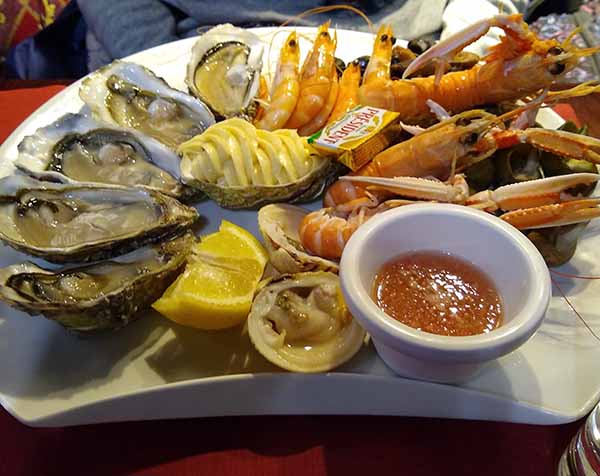 Given the coastline, it would be strange if Normandy weren't good at seafood.
Oysters, mussels, scallops and fish feature heavily, and towns such as Dieppe and Honfleur have strong maritime traditions.
A plate of fresh seafood followed by a selection of local cheeses sounds to me like a perfectly respectable lunch.
Possibly followed by a little walk.
Possibly.
The Weather
And yes, Normandy's weather can be rather like home.
The Atlantic influence means that sunshine isn't guaranteed and rain can appear with impressive enthusiasm.
But just like Brittany, bad weather can actually improve the scenery.
A grey sky over the D-Day beaches or dramatic clouds above the cliffs at Étretat can be far more atmospheric than perfect blue skies.
Just take a coat.
And perhaps an umbrella.
So, Is Normandy Worth Visiting?
Without question.
Normandy manages to pack an extraordinary amount into a relatively compact area.
You have medieval towns, magnificent cathedrals, dramatic cliffs, beautiful countryside, historic harbours, prehistoric and medieval history, the D-Day beaches and Mont-Saint-Michel.
And then there is the food.
Oh, the food.
Where else can you spend the morning contemplating one of the most important military operations in history, the afternoon looking at a medieval tapestry and finish the day eating Camembert while drinking local cider?
That is a pretty good day by my standards.
Final Thoughts
Normandy is one of those places that rewards repeated visits.
There is far too much to see in one trip, and the temptation is to concentrate entirely on the famous sights.
Don't.
Get off the main tourist route occasionally.
Drive through the countryside.
Stop in the little villages.
Visit a local market.
Buy some cheese.
Find a bakery.
Try the cider.
And if you happen to find yourself passing through the village of Camembert, you really have no excuse whatsoever for not stopping.
Normandy combines some of the most important history in Europe with some of the most beautiful countryside and coastline in France.
It is a place of castles, cathedrals, cliffs, beaches, battlefields, apples, butter, cream and an almost indecent amount of cheese.
And that, frankly, makes it rather difficult not to like.
Normandy is close to Britain, steeped in our shared history and blessed with enough scenery and food to make you want to keep coming back. Just remember to leave room for the cheese.
Prices correct as June 2026
Return to France home page