
Stonehenge
Few sights in Britain are as instantly recognisable as Stonehenge. A circle of enormous prehistoric stones standing mysteriously on Salisbury Plain has become one of the country's most famous landmarks, and despite centuries of investigation, nobody can give us a completely convincing answer as to exactly why it was built.
And perhaps that is part of the attraction.
The stones
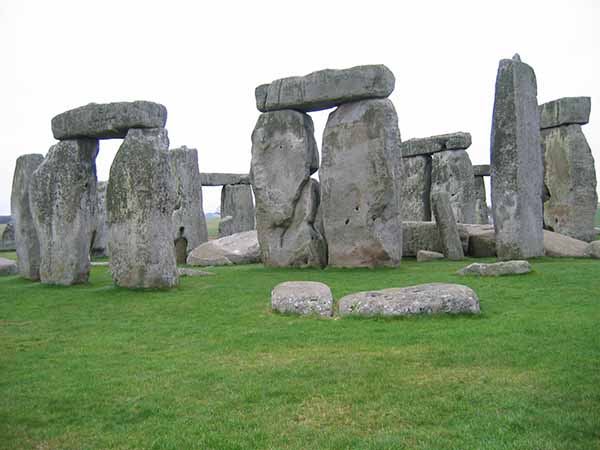 The monument we see today is the result of construction and alteration over many centuries, beginning around 5,000 years ago. The enormous sarsen stones were transported from the Marlborough Downs, while the smaller bluestones came from the Preseli Hills in Wales — an extraordinary achievement when you consider that these people had no lorries, cranes or even wheels.
The stones were carefully arranged, with some forming the familiar outer circle and others creating the inner horseshoe and lintels.
Exactly what it was all for remains the subject of endless debate. It may have been connected with religion, ceremonies, burial, astronomy or some combination of all three. The alignment with the movements of the sun is particularly significant, with the monument famously aligned to the summer and winter solstices.
Whatever its purpose, it clearly mattered enormously to the people who constructed it.
More than just a pile of stones
It is tempting to arrive, take the obligatory photograph and think, “Yes, that's Stonehenge — now where's the café?” - Don't.
The surrounding landscape is an essential part of understanding the monument. The area contains numerous prehistoric burial mounds and other archaeological remains, demonstrating that Stonehenge was part of a much larger ceremonial landscape.
The visitor centre, located away from the stones, provides useful background on the people who built and used the monument, while reconstructions help give an idea of how prehistoric communities lived.
The walk from the visitor centre to the stones is also worthwhile, although there is a shuttle bus for those who would rather conserve their energy.
The mystery
Perhaps Stonehenge's greatest strength is that it doesn't provide all the answers.
We know a great deal about how the monument was constructed, but much less about the beliefs of the people who created it. There are theories aplenty, ranging from serious archaeological explanations to some rather more imaginative ideas involving aliens and ancient civilisations.
I'll leave you to decide which sounds more plausible.
What is beyond doubt is the enormous amount of effort involved. Moving and positioning these massive stones would have required sophisticated organisation, engineering knowledge and a considerable workforce.
That alone makes Stonehenge impressive.
Expect crowds
There is one slight problem with being one of Britain's most famous attractions: everyone else wants to see it too.
Stonehenge can become very busy, particularly during the summer and school holidays. The monument is also roped off, so you cannot wander casually among the stones as visitors once could.
This does mean that the experience isn't quite the romantic encounter with prehistory that some people imagine.
Nevertheless, standing in front of those enormous stones and contemplating their age is an experience that photographs simply cannot reproduce.
The verdict
Stonehenge is one of those places that can be overhyped — but it is famous for a very good reason.
It is ancient, mysterious and technically astonishing, and it represents a remarkable achievement by people living thousands of years before modern technology.
You may not leave knowing exactly why it was built.
In fact, you probably shouldn't.
The unanswered questions are part of the fun.
After 5,000 years, Stonehenge still has the ability to make us wonder what on earth our ancestors were up to — and frankly, that is considerably more interesting than having all the answers.
Opening times: from 09:30 with seasonal closing times
Admission cost: Adult from £34.50 on the day £29.32 in advance, Child 5-17 years) from £17.20 on the day £14.62 in advance. English Heritage members free. Advanced booking highly recommended
(prices quoted correct as at August 2026)
Return to South West home page