
Thames Path: Reading - Windsor
Section Length: 31 miles (49.88 km)
Time Taken: 10 hrs 10 mins
Dates Walked: 6th, 12th, 15th and 19th September 2017
Logistics: This section of the walk was completed in three parts.
The first from Reading to Henley (9 miles). For this I parked in Henley then caught a train to Reading
The second was Henley to Marlow (8.5 miles). For this I drove to Marlow then caught a bus to Henley.
The final leg was Marlow to Windsor (13.5 miles) I again drove to Marlow then two trains back to Marlow at the end
Time Taken: 10 hrs 10 mins
Dates Walked: 6th, 12th, 15th and 19th September 2017
Logistics: This section of the walk was completed in three parts.
The first from Reading to Henley (9 miles). For this I parked in Henley then caught a train to Reading
The second was Henley to Marlow (8.5 miles). For this I drove to Marlow then caught a bus to Henley.
The final leg was Marlow to Windsor (13.5 miles) I again drove to Marlow then two trains back to Marlow at the end
Previous Oxford to Reading Next Windsor to Putney
Leaving Reading behind, the Thames Path heads into a much quieter world than the town might suggest.
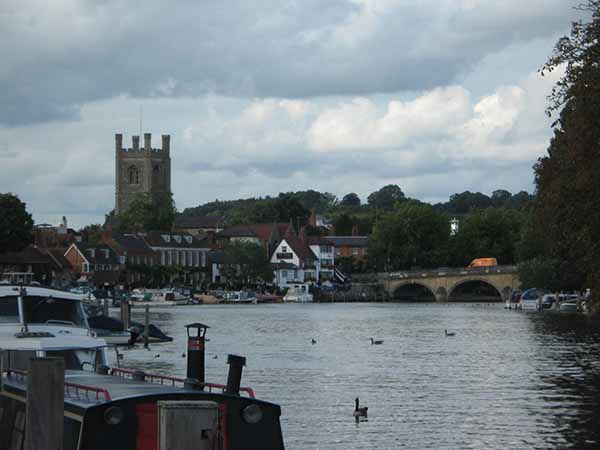 The river is now well established and the walking is mostly through pleasant countryside, with the usual mixture of meadows, woodland, locks and the occasional riverside house. There are more boats around than in the upper reaches, but it still feels a long way from London.
The first major place you come across is Sonning.
Sonning is an attractive little village with an impressive old bridge crossing the Thames. It is also one of those places where you can tell that property prices probably aren't aimed at the average walker. The riverside houses are decidedly smart and the whole place has a rather well-heeled feel.
From Sonning the path continues through countryside towards Shiplake and then Henley country. This is still a very pleasant stretch of the Thames, with the river winding through wooded banks and open fields.
Eventually you reach the area around Wargrave, another attractive Thames village. The walking remains fairly easy-going, although there are sections where the path leaves the immediate riverbank and heads through fields.
This is one of the things I like about the Thames Path. Despite being one of Britain's best-known rivers, it isn't simply one long waterside promenade. There are plenty of occasions when you are sent inland for a while, which keeps things a little more interesting.
Further downstream comes the rather grand village of Bray.
Bray has acquired a reputation for serious food, largely because of the restaurants that have operated here over the years. I'm sure the food is excellent, but unless you have considerably more money than me, you may prefer to admire the place from the outside and carry on walking.
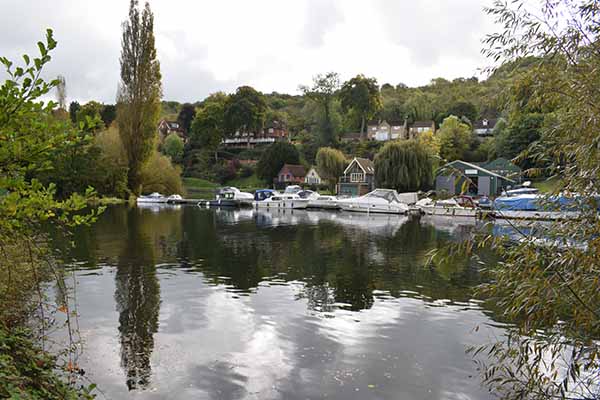 The river then takes you towards Maidenhead and its surrounding countryside. The famous Brunel railway bridge appears again, this time from the opposite direction, and is still an impressive sight.
Beyond Maidenhead the character of the Thames starts to change.
There is more development, more traffic and more evidence that you are getting closer to London. It isn't unpleasant, but the feeling of being in remote countryside is gradually disappearing.
The route passes through areas around Cookham and then towards Bourne End, where the river is particularly attractive. There are wooded stretches, open meadows and plenty of boats, making this a classic Thames scene.
Eventually you reach the outskirts of Windsor.
And this is where the walk gets a bit special.
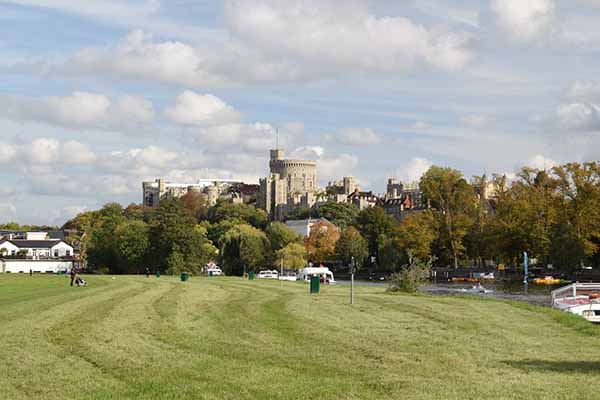 Windsor Castle dominates the skyline long before you get anywhere near the town. It is difficult to ignore something quite that enormous sitting on top of the hill.
The approach to Windsor takes you through pleasant riverside countryside before civilisation gradually takes over. Then suddenly you are dealing with one of the country's most famous tourist destinations.
Windsor itself is busy, particularly around the castle, but it is also a very attractive town. The castle is, of course, the main event and it is difficult not to be impressed by the sheer scale of it.
The Thames continues past Windsor and the famous Long Walk and Great Park are nearby, although the Thames Path itself doesn't simply take you through the middle of the park.
One of the nicest things about arriving in Windsor is the contrast with the start of this section. Back at Reading you are still in a relatively ordinary riverside environment. By Windsor you have reached a place with royal connections, enormous numbers of visitors and one of Britain's most recognisable buildings.
The river itself remains the constant throughout.
Previous Oxford to Reading Next Windsor to Putney
Leaving Reading behind, the Thames Path heads into a much quieter world than the town might suggest.
The river is now well established and the walking is mostly through pleasant countryside, with the usual mixture of meadows, woodland, locks and the occasional riverside house. There are more boats around than in the upper reaches, but it still feels a long way from London.The first major place you come across is Sonning.
Sonning is an attractive little village with an impressive old bridge crossing the Thames. It is also one of those places where you can tell that property prices probably aren't aimed at the average walker. The riverside houses are decidedly smart and the whole place has a rather well-heeled feel.
From Sonning the path continues through countryside towards Shiplake and then Henley country. This is still a very pleasant stretch of the Thames, with the river winding through wooded banks and open fields.
Eventually you reach the area around Wargrave, another attractive Thames village. The walking remains fairly easy-going, although there are sections where the path leaves the immediate riverbank and heads through fields.
This is one of the things I like about the Thames Path. Despite being one of Britain's best-known rivers, it isn't simply one long waterside promenade. There are plenty of occasions when you are sent inland for a while, which keeps things a little more interesting.
Further downstream comes the rather grand village of Bray.
Bray has acquired a reputation for serious food, largely because of the restaurants that have operated here over the years. I'm sure the food is excellent, but unless you have considerably more money than me, you may prefer to admire the place from the outside and carry on walking.
The river then takes you towards Maidenhead and its surrounding countryside. The famous Brunel railway bridge appears again, this time from the opposite direction, and is still an impressive sight.Beyond Maidenhead the character of the Thames starts to change.
There is more development, more traffic and more evidence that you are getting closer to London. It isn't unpleasant, but the feeling of being in remote countryside is gradually disappearing.
The route passes through areas around Cookham and then towards Bourne End, where the river is particularly attractive. There are wooded stretches, open meadows and plenty of boats, making this a classic Thames scene.
Eventually you reach the outskirts of Windsor.
And this is where the walk gets a bit special.
Windsor Castle dominates the skyline long before you get anywhere near the town. It is difficult to ignore something quite that enormous sitting on top of the hill.The approach to Windsor takes you through pleasant riverside countryside before civilisation gradually takes over. Then suddenly you are dealing with one of the country's most famous tourist destinations.
Windsor itself is busy, particularly around the castle, but it is also a very attractive town. The castle is, of course, the main event and it is difficult not to be impressed by the sheer scale of it.
The Thames continues past Windsor and the famous Long Walk and Great Park are nearby, although the Thames Path itself doesn't simply take you through the middle of the park.
One of the nicest things about arriving in Windsor is the contrast with the start of this section. Back at Reading you are still in a relatively ordinary riverside environment. By Windsor you have reached a place with royal connections, enormous numbers of visitors and one of Britain's most recognisable buildings.
The river itself remains the constant throughout.
Previous Oxford to Reading Next Windsor to Putney